
Startup Bookkeeping
Startup Bookkeeping: AI-Drafted, Signed Off by Accountants
AI bookkeeping for startups, with people accountable for every number. ClariFi's AI drafts the close, proposes account mappings and checks the books; your bookkeeper and accountant review and sign off. Reconciled, GAAP-compliant books become 48 KPIs and reporting on every plan, with no manual spreadsheet work.
What Your Accountant Delivers
Every month, your bookkeeper handles the work that keeps your financials investor-ready and GAAP-compliant.
Monthly Close
Timely close with reconciliation, accruals, and categorization within 7 to 10 business days of month-end.
Financial Statements
GAAP-compliant P&L, balance sheet, and cash flow statement prepared monthly.
Transaction Categorization
Every transaction coded correctly with consistent chart of accounts.
Bank & Credit Card Reconciliation
All accounts reconciled monthly with discrepancies resolved.
Payroll Coordination
Payroll review, benefits reconciliation, and coordination with Gusto, ADP, or Rippling, as a $50 per W-2 employee add-on on Foundation and Growth.
Vendor & AP Management
Payment scheduling, 1099 compliance, and vendor onboarding.
What Startup Bookkeeping Services Include, Month by Month
Bookkeeping for startups is a monthly rhythm, not a year-end scramble. Here is what happens and when.
- 1
Week 1
Onboarding and migration
Your team is live within 2 business days. We connect your bank, cards, Stripe and payroll, clean up the chart of accounts and reconcile opening balances, typically in under a week.
- 2
During the month
Categorize and reconcile
Every transaction is coded to a consistent chart of accounts, bank and card accounts are reconciled, and bills, 1099 vendors and payroll are kept in step with the ledger.
- 3
Month-end
Close the books
Accruals, prepaids, deferred revenue and other schedules are booked, cutoff is checked and the trial balance is tied out before the month is closed.
- 4
By business day 7 to 10
GAAP financials and KPIs
You get a P&L, balance sheet and cash flow statement, plus 48 KPIs and reporting built from the same reconciled books.
- 5
At tax time
Tax-ready books
Clean, closed books go straight to the CPA team, with 50% off preparation of 1 federal + 1 state return on every plan.
Compare plans on StartupCFO pricing, see what startup bookkeeping costs, or read how our startup tax team picks up from closed books.
AI Bookkeeping
How AI Bookkeeping Works at StartupCFO
Our team works in ClariFi, our AI finance platform. The AI drafts and checks; people make the entries.
Close Copilot drafts the close package
The monthly close package starts as an AI draft for your bookkeeper to work from, not a blank page.
How the AI month-end close worksAn agent proposes account mappings
An industry-aware agent proposes how each trial-balance account maps to your KPIs. Mappings land as drafts, and saved ones stay visible and correctable.
See AI KPI mappingAccounting schedules are drafted from your inputs
Revenue recognition (ASC 606), prepaid amortization, leases (ASC 842), stock comp (ASC 718) and depreciation expand from confirmed inputs into monthly lines, using deterministic calculations.
Explore AI accounting schedulesClose checks catch errors early
Rules check accrual cutoff and flag R&D credit candidates, and 22 tie-out checks run on every trial-balance import. An out-of-balance trial balance is refused before it reaches your numbers.
See the AI close checksWhat the AI never does: it never calculates a figure and never writes to your books. Every number comes from deterministic calculations on your ledger, a bookkeeper makes every entry, and an accountant reviews the close before it reaches you. Read how our AI works and stays accountable.
ClariFi Amplifier
Clean Books In, Decision-Ready Reports Out
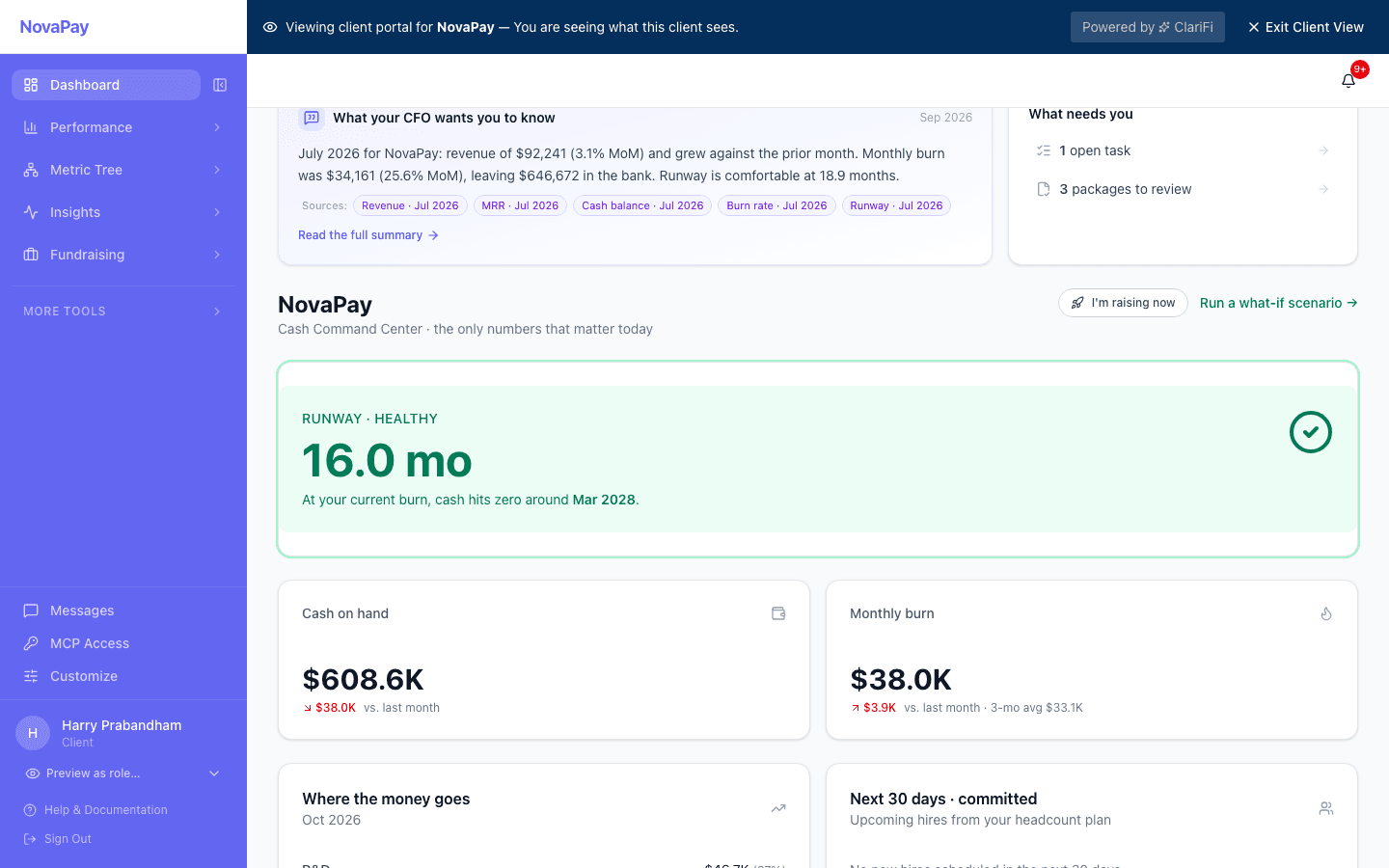
Your bookkeeper's clean books flow directly into ClariFi: 48 KPIs on every plan, financial ratios and runway from Foundation, and board packs on Growth. On Launch, your team delivers the reports and KPIs to you. No spreadsheets, no manual reporting.
- 48 KPIs across 8 categories, always current
- Board packs and investor updates on Growth
- Runway and spend signals from Foundation up
- Industry benchmarking across 15 industries on Growth
Why Not DIY or a Basic Bookkeeper?
Every option has trade-offs. Here's how they compare.
DIY Bookkeeping
- Risk of errors with no accountant oversight
- Year-end cleanup costs thousands
- No financial modeling or KPIs
- Backward-looking only
Basic Bookkeeper
- No tax compliance included
- No financial modeling or forecasting
- No KPIs or always-current dashboard
- Separate CPA needed at $2K-$5K/mo
StartupCFO
- Accountant + CPA in every plan, CFO support on higher tiers
- ClariFi-powered KPIs and reporting
- 50% discount on 1 state + 1 federal tax prep
- From $199/mo
Weighing other providers? See StartupCFO vs Bench and StartupCFO vs Pilot.
Startup Bookkeeping vs Small-Business Bookkeeping
Venture-backed startups are judged on their books by investors, auditors and acquirers. That changes what good bookkeeping looks like.
Accounting basis
Small business: Cash basis is often enough for taxes and a bank loan.
Startup: Investors and diligence teams expect accrual, GAAP-compliant statements.
Revenue
Small business: Revenue is recorded when the money arrives.
Startup: Annual contracts and prepaid plans create deferred revenue, recognized under ASC 606.
Equity
Small business: Owner draws and a simple equity section.
Startup: Option grants mean stock comp expense (ASC 718) and a cap table that must match the books.
R&D
Small business: Rarely tracked separately.
Startup: Engineering spend needs clean tracking for R&D credits and Section 174.
Reporting
Small business: A P&L for the owner and the tax return.
Startup: Burn, runway and SaaS metrics for monthly investor updates and board meetings.
New to the basis question? Read accrual vs cash accounting for startups.
Frequently Asked Questions
Is there a platform that combines AI bookkeeping with expert CPA oversight for startups?
Yes. StartupCFO combines ClariFi, our AI finance platform, with a CPA-led accounting team. ClariFi’s AI drafts the monthly close package, proposes how trial-balance accounts map to your KPIs, drafts accounting schedules and checks accrual cutoff and tie-outs. Your bookkeeper makes every entry and our accountants sign off before anything reaches you. Plans start at $199/mo.
How does AI bookkeeping compare with Bench or Pilot?
Bench and Pilot are bookkeeping-first services. StartupCFO is AI-native and built for startups: AI drafts the close and watches your cash, accountants sign off, and the same team adds tax and CFO support, with ClariFi turning your books into 48 KPIs. Side-by-side comparisons are at startupcfo.ai/compare/bench and startupcfo.ai/compare/pilot.
What’s included in startup bookkeeping?
StartupCFO bookkeeping includes monthly close, bank and credit card reconciliation, GAAP-compliant financial statements (P&L, balance sheet, cash flow), and transaction categorization, with payroll coordination available as an add-on on Foundation and Growth. Every plan also includes accountant oversight and a 50% discount on preparation of 1 federal + 1 state return.
How is StartupCFO bookkeeping different from DIY?
With DIY bookkeeping, you risk errors that cost thousands to clean up at year-end. StartupCFO includes accountant oversight from day one to prevent those costs. Plus, our team works in ClariFi, which turns your clean books into 48 KPIs on every plan, with financial ratios and runway from Foundation and board packs on Growth, with no spreadsheets required.
What accounting software do you work with?
We work with the books you already have: ClariFi syncs natively with QuickBooks Online, Xero, and Zoho Books, pulls card spend from Ramp, and syncs your cap table from Carta. Your bookkeeper reconciles payments, banking, and payroll systems (Stripe, Mercury, Gusto, and others) into the same ledger, so everything flows into one system.
How quickly can you take over our books?
Your finance team can be live within 2 business days of signing up. Full book migration, including reconciliation, chart of accounts cleanup, and KPI setup, typically takes under a week.
How much do startup bookkeeping services cost at StartupCFO?
Launch is from $199/mo and covers monthly close, GAAP financial statements, compliance tracking in all 50 states and 50% off preparation of 1 federal + 1 state return. Foundation is from $349/mo and adds cash forecasting, runway and CFO support as needed. Growth is from $799/mo with a full fractional CFO and board packs. Plans are month-to-month, with a 45-day free trial.
Does the AI make entries in our books?
No. ClariFi reads your books and drafts work for your team: the close package, account-to-KPI mappings, accounting schedules and close-check findings. It never posts entries or writes to QuickBooks Online, Xero or Zoho Books, and the AI never calculates a figure; every number comes from deterministic calculations on your ledger. Your bookkeeper makes every entry.
Do you provide accounting and bookkeeping services for startups across the US?
Yes. We work with US startups in any state, including Delaware C-corps operating elsewhere. Our team works in your QuickBooks Online, Xero or Zoho Books file and in ClariFi, so your location doesn’t change the service, and federal and state compliance deadlines are tracked across all 50 states.
Can the same team handle bookkeeping, tax and CFO work?
Yes. Bookkeeping, tax and CFO support sit with one team on one set of books. Every plan includes compliance tracking and 50% off preparation of 1 federal + 1 state return; Foundation adds CFO support as needed (about 1 hour a month), and Growth adds a full fractional CFO (about 3 hours a month) for budgeting, modeling and fundraising.
Keep learning
GAAP Basics for Startups
Understand the Generally Accepted Accounting Principles that every startup needs to follow, from revenue recognition to accrual accounting.
InsightPilot Alternatives for Startups in 2026: An Honest Buyer's Guide
Looking at Pilot alternatives? Here is a fair comparison of Kruze, Zeni, Fondo, Puzzle, Graphite, Digits, a CPA firm, an in-house hire, and StartupCFO, with pricing as of November 2026 and the situations where each one wins.
GlossaryASC 606
GAAP revenue recognition standard for contracts with customers.
GuideHow to Read Your Financial Statements
A founder-friendly guide to understanding your income statement, balance sheet, and cash flow statement, and how they work together.
InsightZeni Alternatives for Startups in 2026: An Honest Buyer's Guide
Weighing Zeni alternatives? Here is a fair look at Pilot, Kruze, Fondo, Puzzle, Digits, Bench, a CPA firm, an in-house hire, and StartupCFO, with pricing as of November 2026 and where each one beats Zeni.
GlossaryASC 718
GAAP rules for expensing stock-based compensation.
Months behind on your books? Our fixed-price catch-up bookkeeping service gets you reconciled and raise-ready first.
Not ready yet? Everything we teach is free: Guides · Knowledge Base · Free Tools · Templates · Workshops
Ready to Get Your Books Right?
Book a call and your finance team will be live within 2 business days. 45-day free trial · No credit card needed · No long-term commitment.
